

Learn how the Model Context Protocol (MCP) updates fix LLM context rot. Build server rendered UIs for autonomous AI agents securely.
Let's be honest about the state of enterprise AI: most chat interfaces are a massive bottleneck.
Over the last two years, companies have built brilliant, highly capable agents, only to drag them down by forcing them to communicate through slow, token-chugging chatboxes. If a customer needs to check their cloud billing, track a shipping container, or change a flight booking, they do not want to watch three paragraphs of text stream in at 30 tokens per second. It is slow, it inflates your API bills, and frankly, it ruins the user experience.
This is the chatbox trap. And the way out is MCP Apps.
By adopting the open-standard Model Context Protocol (MCP), we are seeing a massive shift away from text-based agent outputs. Instead of typing out what they did, modern AI agents now serve Server-Rendered, interactive web interfaces directly inside the client view.
Here is exactly how this architecture works under the hood, the realities of the latest specs, and what it takes to build them at scale.
What is an MCP App?
An MCP App is an agentic UI application where the AI Agent acts as a runtime engine, pulling secure database resources and dynamic user interface components from an MCP (Model Context Protocol) Server, rendering them as interactive, stateful web interfaces rather than text-based LLM outputs.
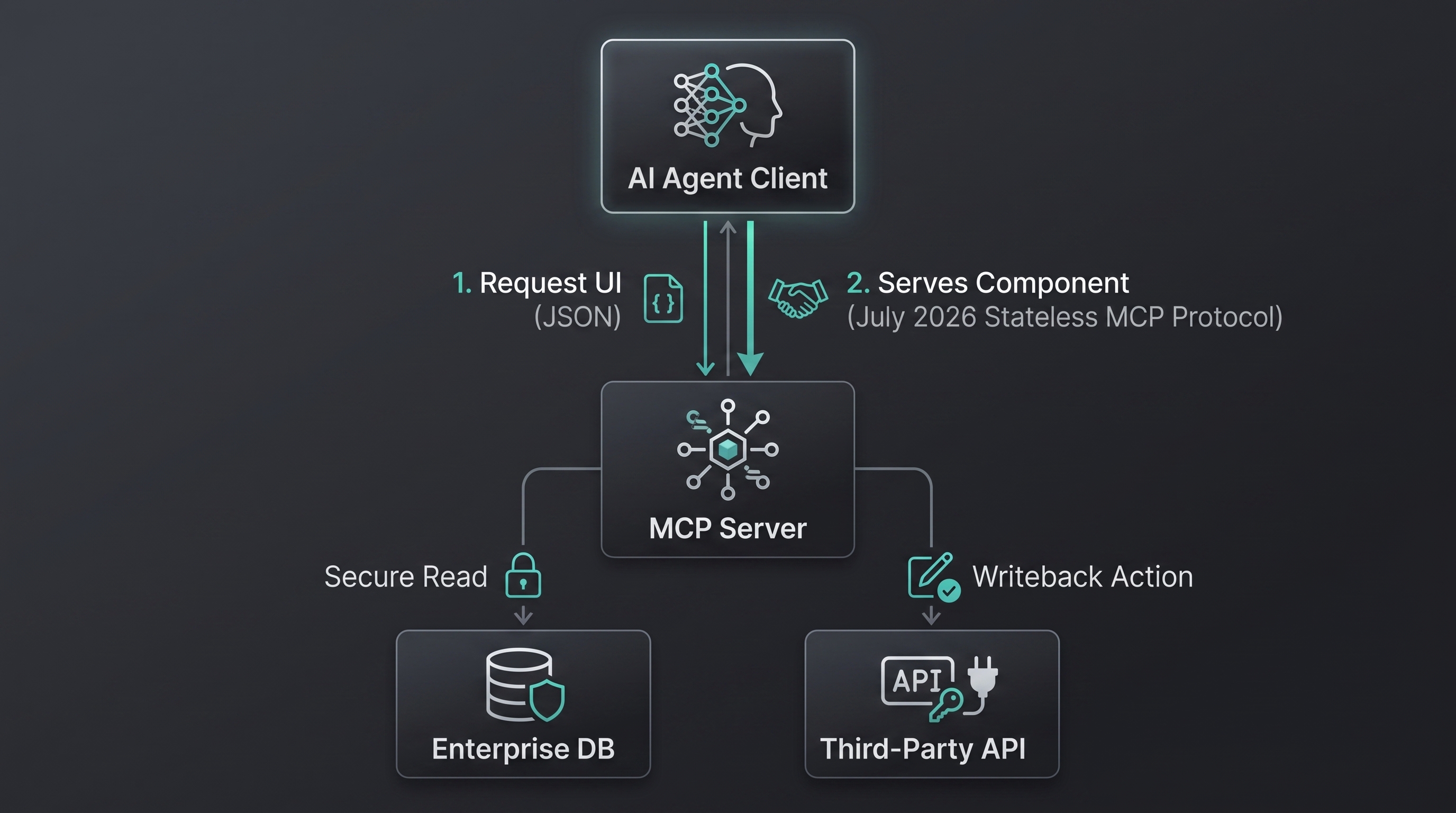
In a standard setup, an MCP App splits the workload. The agent's LLM handles the logic, understanding, and intent orchestration, while the MCP Server handles secure database connections, API calls, and component layout generation.
Instead of treating the AI like a glorified translator that reads a database payload and drafts a text summary, the agent simply requests a structured UI layout. The latency savings here are basic math.
Let T_total be the total transaction latency, T_tokens be the time required to generate natural language tokens, and T_render be the time to parse and render a static component payload. Because LLM generation is sequential, serving pre-built UI components is orders of magnitude faster:
T_total = T_tokens(N) + T_network is vastly greater than T_render + T_network
By keeping the token count N close to zero and serving a serialized UI layout, you slice your user latency from seconds down to milliseconds.
What Changed in the July 2026 Stateless MCP Core Spec
If you built early MCP prototypes, you probably ran into the "Agent Session Bloat" problem. Servers tried to maintain connection states for thousands of active users, causing severe scale and memory bottlenecks.
The updated stateless protocol core released in July 2026 changes the game. The MCP Server now acts as a pure, functional UI generator. When a user clicks an interactive element inside an agent-rendered dashboard, the loop runs like this:
- Intent Mapping: The client translates the user's click or interaction into an action vector.
- Context Passing: The agent requests a fresh UI component from the stateless MCP Server, passing the user’s tokenized state context:
State_next = f(Context_current, Action) - Dynamic Assembly: The MCP Server fetches the secure corporate data, wraps it in a serialized React Server Component (RSC) payload, and passes it back over the stateless tunnel.
- Instant Mounting: The client parses the JSON layout and mounts the UI instantly.
The LLM never has to write a single token to update the dashboard. It is simply acting as a dynamic state machine director.
The Real-World Engineering Bottlenecks of MCP
While spinning up a basic open-source MCP template on your local machine is simple, taking this architecture to production inside an enterprise environment brings up massive security and operational hurdles:
- Context Poisoning: If your agent has raw access to your database MCP tools, a malicious user can run prompt injection attacks to force the agent into requesting UI components containing sensitive customer data. Protecting your endpoints requires building a strict intermediary validation gateway.
- The Component Sync Nightmare: Your client-side UI and your MCP Server schemas have to stay perfectly in sync. If your product team updates a button component in your core application and your MCP serialization schemas don't have robust version gating, your agentic UI is going to crash instantly.
- API Security & Key Delegation: Your MCP Servers need to handle authentication without exposing raw backend API keys to client-side LLM environments. This requires establishing secure, ephemeral credential delegation pipelines.
Turn Your Chatbot into an App
If you are still forcing your customers to wait on text-generation loaders, you are overpaying for tokens to deliver a slow, frustrating product.
At Groooh, we build secure, enterprise-grade, stateless MCP architectures. We connect design systems, React Server Components, and multi-agent LLM systems into production-ready platforms.
Ready to get out of the chatbox trap?
Book an MCP Feasibility & Architecture Scan with our team. In 30 minutes, we will:
- Review your current database and API endpoints.
- Identify the exact workflows that can be optimized with Server-Rendered Agentic UIs.
- Provide a clear technical roadmap to cut your token latency by up to 70%.
A seasoned systems architect with over a decade of experience guiding venture-backed startups and growth teams from 0-to-1 MVP delivery to scale. Specializes in cross-platform mobile architectures, resilient cloud infrastructure, and applied agentic AI integrations that drive measurable commercial impact.
Add Groooh to Preferred Sources
Top Stories & AI Overviews
Prioritize our engineering & AI guides in your Google Top Stories & AI Overviews.
Ready to build your next breakthrough product?
Let’s collaborate on your architecture roadmap, MVP sprint, or full product build with our senior team.