


Compare Gemini 4 Argon, GPT-6 Astra, and Claude Fable 5.1 on benchmarks, pricing, context, and best use cases. Find out which model fits your work.
Which is better: Gemini 4 Argon, GPT-6 Astra, or Claude Fable 5.1?
No single model wins every task. In Google's October 2026 comparison, Gemini 4 Argon leads most knowledge-work, legal, finance, long-context, and multimodal tests, while GPT-6 Astra leads on FrontierSWE v2, Terminal-Bench Science, and OSWorld computer use. Claude Fable 5.1 trails both on most rows but stays competitive in coding (Google DeepMind model card). These are vendor-reported numbers, so test each model on your own work before you commit.
The three models launched within six weeks of each other: Fable 5.1 on September 1, Astra on September 4, and Argon on September 30, with broad availability from October 13. This guide compares what each one is, what it costs, what the benchmarks show and do not show, and how to choose between them or route work across all three.
Building an AI product and unsure which model should handle which task? Send us your use case and we will recommend a model and routing setup. Request a free 30-minute AI architecture review
How do the three models compare on specs and price?
All three offer about 1 million tokens of context, so context size alone does not separate them. The real differences are output limit, price per token, and what each vendor positions the model for.
| Gemini 4 Argon | GPT-6 Astra | Claude Fable 5.1 | |
|---|---|---|---|
| Maker | Google DeepMind | OpenAI | Anthropic |
| Released | Announced Sep 30, 2026; broadly available Oct 13 | Sep 4, 2026 (limited preview Sep 3) | Sep 1, 2026 |
| Context window | Up to 1M tokens, input and output combined | About 1.05M tokens | 1M tokens |
| Maximum output | Up to 1M tokens | Not verified | 128K tokens |
| Price per 1M tokens (input / output) | $2 / $10 introductory, then $4 / $20 | $10 / $50 | $10 / $50 |
| Positioned for | Software engineering, legal and finance work, cyber defense | Computer use, coding, cybersecurity, science | Demanding reasoning and long-horizon agentic work |
Sources: Google model card and Google announcement for Argon, OpenRouter and OpenAI for Astra, and Anthropic's model documentation for Fable 5.1. Prices are list prices at launch and change, so check each vendor before budgeting.
What the table shows. Argon's standout spec is its 1M-token output limit, up from 64K in the previous generation, which lets it write very long answers in one pass (Google). Fable 5.1's maximum output is 128K tokens. Google's announced introductory price for Argon is one fifth of the other two models' list price per token, rising to two fifths after the introductory period.
Price per token is not price per task. Models differ in how many tokens they spend on a task. One report found Fable 5.1 at maximum effort used about 1.7 times the output tokens of Fable 5, which made it cost about 20 percent more per task even at the same list price (The Decoder). Measure cost on your own tasks.
Access and safeguards differ too.
- Argon reached trusted cyber defenders first through Google's Fairwind Program, then became broadly available on October 13. Google says it cannot rule out that the model reaches its biological and cybersecurity critical capability levels, and applies safeguards for both.
- Astra rolled out first to a limited set of organizations. OpenAI says it is the first model to reach the Critical level of cybersecurity capability under its Preparedness Framework (OpenAI).
- Fable 5.1 is the version of Anthropic's top model with extra safeguards. Anthropic's documentation tells developers to handle classifier refusals and retry on another Claude model, so plan for fallbacks on sensitive tasks (Anthropic).
What do the benchmarks show, and how far can you trust them?
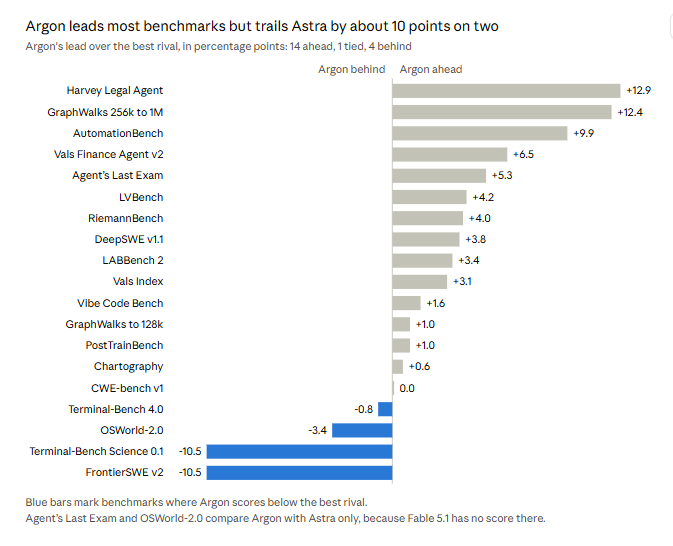
Argon leads on knowledge work, legal and finance agents, long-context retrieval, and multimodal tests. Astra leads where the work is autonomous and tool-driven: FrontierSWE v2, Terminal-Bench Science, and OSWorld computer use. Fable 5.1 leads no row of Google's table, but it sits within about three points of the leader on Vibe Code Bench, Terminal-Bench 4.0, and the Vals Index.
| Category | Benchmark | Gemini 4 Argon | GPT-6 Astra | Claude Fable 5.1 |
|---|---|---|---|---|
| Knowledge work | Vals Index | 68.9% | 63.1% | 65.8% |
| AutomationBench | 51.3% | 41.4% | 31.4% | |
| Vals Finance Agent v2 | 65.4% | 53.5% | 58.9% | |
| Harvey's Legal Agent Benchmark | 19.6% | 5.4% | 6.7% | |
| Agentic coding and ML | DeepSWE v1.1 | 77.9% | 74.1% | 67.4% |
| FrontierSWE v2 | 55.0% | 65.5% | 56.3% | |
| Vibe Code Bench | 91.9% | 89.6% | 90.3% | |
| Terminal-Bench 4.0 | 57.4% | 58.2% | 57.9% | |
| PostTrainBench | 45.3% | 44.3% | 40.2% | |
| Science and math | Terminal-Bench Science 0.1 | 57.6% | 68.1% | 52.6% |
| LABBench 2 | 88.8% | 85.4% | 68.6% | |
| RiemannBench | 76.0% | 72.0% | 65.6% | |
| Long context | GraphWalks, up to 128k | 99.7% | 98.7% | 91.4% |
| GraphWalks, 256k to 1M | 84.2% | 71.8% | 65.0% | |
| Computer use | Agent's Last Exam | 39.5% | 34.2% | No score |
| OSWorld-2.0 | 69.2% | 72.6% | No score | |
| Multimodal | Chartography | 71.6% | 71.0% | 46.2% |
| LVBench | 91.7% | 87.5% | 79.7% | |
| Cybersecurity | CWE-bench v1 | 68.0% | 68.0% | 58.0% |
Bold marks the best of these three models on each row. Source: Google DeepMind model card.
Four reasons to hold these numbers loosely.
- They come from the maker of one of the models. The table is Google's, published with Argon's launch, and the competitor scores are Google's figures. Google publishes its evaluation methodology separately.
- Scores vary by source. Anthropic reports 55.8% for Fable 5.1 on Terminal-Bench 4.0 (The Decoder), while Google lists 57.9%. Vals AI lists Fable 5.1 at 67.87% on the Vals Index (Vals AI), against 65.8% in Google's table. Different test harnesses and effort settings explain gaps like these.
- The table leaves out a fourth model. Google's table also lists Claude Opus 5.5, which scores highest on Terminal-Bench 4.0 (66.4%) and PostTrainBench (49.3%). It is omitted above to keep the comparison to three models.
- Independent rankings changed over time. At its September launch, Fable 5.1 ranked first on Vals AI's Vals Index and on Artificial Analysis's Intelligence Index (Vals AI, heise), before Argon was released. Check the latest independent results before you decide.
Which model fits which job?
Pick by the benchmark rows that resemble your work, not by the overall winner. On current vendor evidence, Argon fits document-heavy and business-workflow jobs, Astra fits autonomous terminal and computer-use jobs, and Fable 5.1 is a competitive all-round option that Anthropic positions for demanding reasoning and long agentic runs.
| Job | Best fit on current evidence | Evidence | Caution |
|---|---|---|---|
| Legal research and drafting | Argon | Leads Harvey's Legal Agent Benchmark at 19.6%, against 6.7% for Fable 5.1 and 5.4% for Astra | Even the leader passes under 20% of tasks, so keep a lawyer in the loop |
| Financial analysis | Argon | Leads Vals Finance Agent v2 at 65.4%, against 58.9% and 53.5% | Test on your own filings and models |
| Very large document sets | Argon | Leads GraphWalks from 256k to 1M tokens at 84.2%, against 71.8% and 65.0% | All three offer about 1M tokens of context, so the gap is in recall quality, not size |
| Business workflow automation | Argon | Leads AutomationBench at 51.3%, against 41.4% for Astra and 31.4% for Fable 5.1 | Results depend on which apps and permissions your workflows touch |
| Autonomous coding in a terminal | Mixed | Argon leads DeepSWE v1.1, Astra leads FrontierSWE v2 and Terminal-Bench 4.0, and Fable 5.1 stays close on Vibe Code Bench | Run each model on a sample of your own repository |
| Computer use and desktop automation | Astra | Leads OSWorld-2.0 at 72.6%, against 69.2% for Argon | Fable 5.1 has no score in Google's table, and Argon leads Agent's Last Exam |
| Scientific and ML research | Astra, with exceptions | Leads Terminal-Bench Science at 68.1%, while Argon leads LABBench 2 and RiemannBench | Rankings flip between science benchmarks |
| Customer-facing writing and tone | No clear winner | No benchmark in the table measures tone or voice | Each vendor claims strong writing, so run a blind comparison on your own content |
Two cautions apply across the table. First, different benchmarks for the same job can rank the models differently: on Legal Research Bench, Vals AI shows Fable 5.1 matching the top score of 55.29%, while Argon leads on agentic legal work (Vals AI). Second, access and safeguards affect real projects as much as scores. Cyber and biology related requests may be restricted or routed differently on each model, as described above. Evidence is from Google's model card unless linked otherwise.
How do you choose between them for your own project?
Shortlist with benchmarks, then decide with your own data. A test of 20 real examples per task, scored blind, tells you more than any leaderboard, and it takes a day or two.
- List your three most valuable tasks. For each, collect 20 real examples with the answer you would accept.
- Shortlist using the matching benchmark rows. Use the job table above, not the overall winner.
- Run the same examples on all three models. Fix the effort setting, keep the prompts identical, and have someone score the outputs without knowing which model wrote them.
- Measure cost and speed per task. Price per token hides differences in how many tokens each model spends. Record the cost and the time for each finished task.
- Check where each model is available. Argon is offered through the Gemini API, Google AI Studio, Gemini for business, and Antigravity (Google). Astra is offered through the OpenAI API, Microsoft Azure, and Amazon Bedrock (OpenAI). Fable 5.1 is offered through the Claude API, Amazon Bedrock, Google Cloud, and Microsoft Foundry (Anthropic). Your cloud contract may decide for you.
- Route instead of picking one. Send each task type to the model that won your test, keep a default for everything else, and add a fallback model for requests a model refuses or cannot complete.
Do not forget the cheaper tier. Each vendor also sells smaller models, such as Gemini 3.8 Flash, GPT-6 Sol and Luna, and Claude Opus 5 at $5 per million input tokens (OpenAI, Anthropic). Many tasks do not need a frontier model, and a cheaper model that passes your test is the better choice.
For the engineering side of routing, see our guides on LangGraph versus LangChain for stateful agents, how to make different LLMs work together, and agent harnesses for production.
When is this comparison wrong for you?
A model comparison goes stale quickly and misleads in five situations.
- The benchmark does not resemble your work. A model that leads a legal agent test may still be the wrong choice for short customer replies. Weight the rows that match your tasks and ignore the rest.
- The scores depend on the test setup. The same model scores differently under different harnesses, tools, and effort settings. OpenAI, for example, reports its own results using its own Genie harness (OpenAI). Your setup will not match anyone's launch chart.
- The numbers will move. Three flagship models arrived in six weeks, and each vendor is shipping point releases. Pin a model version in production and re-run your test every month or two.
- You need one vendor. Procurement, data residency, or a small team can make a single model the better choice. Routing across three vendors adds contracts, monitoring, and failure points.
- The prompt matters more than the model. Clearer instructions, better examples, and good retrieval also change results, so test those before paying for a bigger model.
Frequently asked questions
What is Gemini 4 Argon?
Gemini 4 Argon is Google DeepMind's frontier model for software engineering, legal and finance work, and cyber defense. Google announced it on September 30, 2026 and made it broadly available on October 13. It supports up to 1 million tokens of output, up from 64K in the previous generation (Google).
What is GPT-6 Astra?
GPT-6 Astra is OpenAI's flagship model, released on September 4, 2026. OpenAI positions it for computer use, coding, cybersecurity, and science. It has a context window of about 1.05 million tokens and costs $10 per million input tokens and $50 per million output tokens (OpenAI, OpenRouter).
What is Claude Fable 5.1?
Claude Fable 5.1 is Anthropic's model released on September 1, 2026. It has a 1 million token context window, a 128K maximum output, and a price of $10 per million input tokens and $50 per million output tokens. It is the version of Anthropic's top model that includes extra safeguards (Anthropic).
Which model is best for coding?
There is no single winner. In Google's table, Argon leads DeepSWE v1.1, Astra leads FrontierSWE v2 and narrowly leads Terminal-Bench 4.0, and Fable 5.1 stays within two points of the leader on Vibe Code Bench. Run all three on a sample of your own repository before choosing.
Which model is cheapest to run?
Argon has the lowest announced list price: $2 per million input tokens and $10 per million output tokens during its introductory period, then $4 and $20. Astra and Fable 5.1 list at $10 and $50. Cost per task also depends on how many tokens each model uses, so measure it on your own work.
Can I use more than one model in the same product?
Yes, and many teams do. Route each task type to the model that won your own test, keep a default model for everything else, and add a fallback for requests a model refuses or cannot complete. The cost is extra monitoring and more vendor contracts.
Get help choosing and routing AI models
Send us your use case and we will run your tasks across the models, then recommend a model, a routing setup, and a fallback plan. Request your free AI architecture review
Groooh builds agentic AI systems, React Native mobile apps, and full-stack web products for clients in the US, UK, and Europe. Learn more about our agentic AI development service. Last updated October 15, 2026. Disclosure: our team uses Claude Code, which is built on Anthropic's models, on some of its own projects.
Related reading
- AI Protocol Standards 2026: How to Make Different LLMs Talk to Each Other
- Harness Engineering: Why Autonomous AI Agents Need Production-Grade Agent Harnesses
- LangGraph vs LangChain: Why Your Agency Should Be Building Stateful AI Agents
- The 2026 AI Stack: Pinecone, LangGraph, Supabase, and the Model Registry
Sources
Sources reviewed October 15, 2026. Scores, prices, and availability change often, so confirm against each vendor before you decide.
- Gemini 4 Argon model card, Google DeepMind: benchmark table, context and output limits, distribution, limitations, frontier safety assessment
- Gemini 4 Argon: our next era of frontier intelligence, Google: announcement, introductory pricing, 1M token output limit, Fairwind rollout
- GPT-6 Astra: A new generation of intelligence, OpenAI: positioning and availability
- Safety overview: GPT-6 Astra, OpenAI: cybersecurity capability level
- GPT-6 Astra: The next generation in intelligence for work, OpenAI: harness used for reported results
- Introducing GPT-6 Sol and Luna, OpenAI: cheaper GPT-6 models
- GPT-6 Astra on OpenRouter, OpenRouter: context window and list price
- Claude Fable 5.1 model overview, Anthropic: context window, maximum output, pricing, availability, refusal handling
- Anthropic's Claude Fable 5.1 promises better coding and research at up to 45 percent less, The Decoder: Terminal-Bench 4.0 score and cost per task
- Claude Fable 5.1 on Vals AI, Vals AI: independent Vals Index, Legal Research Bench, and Harvey's Legal Agent Benchmark results
- Anthropic enhances Claude: Fable 5.1 takes the benchmark lead, heise: Artificial Analysis Intelligence Index at launch
Atif Ali
Full Stack Engineer
Full-Stack Engineer at Groooh with extensive expertise in cross-platform mobile development and cloud systems. Specializes in building unified digital ecosystems using React Native, Next.js, and PostgreSQL. Known for writing maintainable, test-driven code and optimizing app performance from database query tuning down to 60fps mobile UI interactions.
Ready to build your next breakthrough product?
Let’s collaborate on your architecture roadmap, MVP sprint, or full product build with our senior team.