



Discover Harness Engineering. Learn how to build production-grade TypeScript agent harnesses with execution sandboxes, step limits, and state tracking.
Building an AI agent prototype with an open-source framework or a few lines of LangChain code is easy. You define a prompt, give the model a handful of tool definitions, and watch it complete a simple multi-step task.
Taking that agent into a production environment is where everything breaks down.
When autonomous AI agents interact with real databases, third-party APIs, and customer records, raw LLM loops become dangerous. An unconstrained model will eventually hit an infinite reasoning loop, hallucinate invalid arguments for an external tool, or execute a destructive API call when a step fails.
This reliability gap has given rise to a crucial discipline in enterprise software: Harness Engineering.
What is Harness Engineering?
Harness Engineering is the practice of designing deterministic runtime environments, called Agent Harnesses, that enclose non-deterministic large language models.
Instead of letting the LLM directly manage its own execution lifecycle, the Agent Harness acts as an operational supervisor. It intercepts every tool request, validates input parameters against strict runtime schemas, enforces iteration limits, logs audit trails, and handles network or logic failures safely.
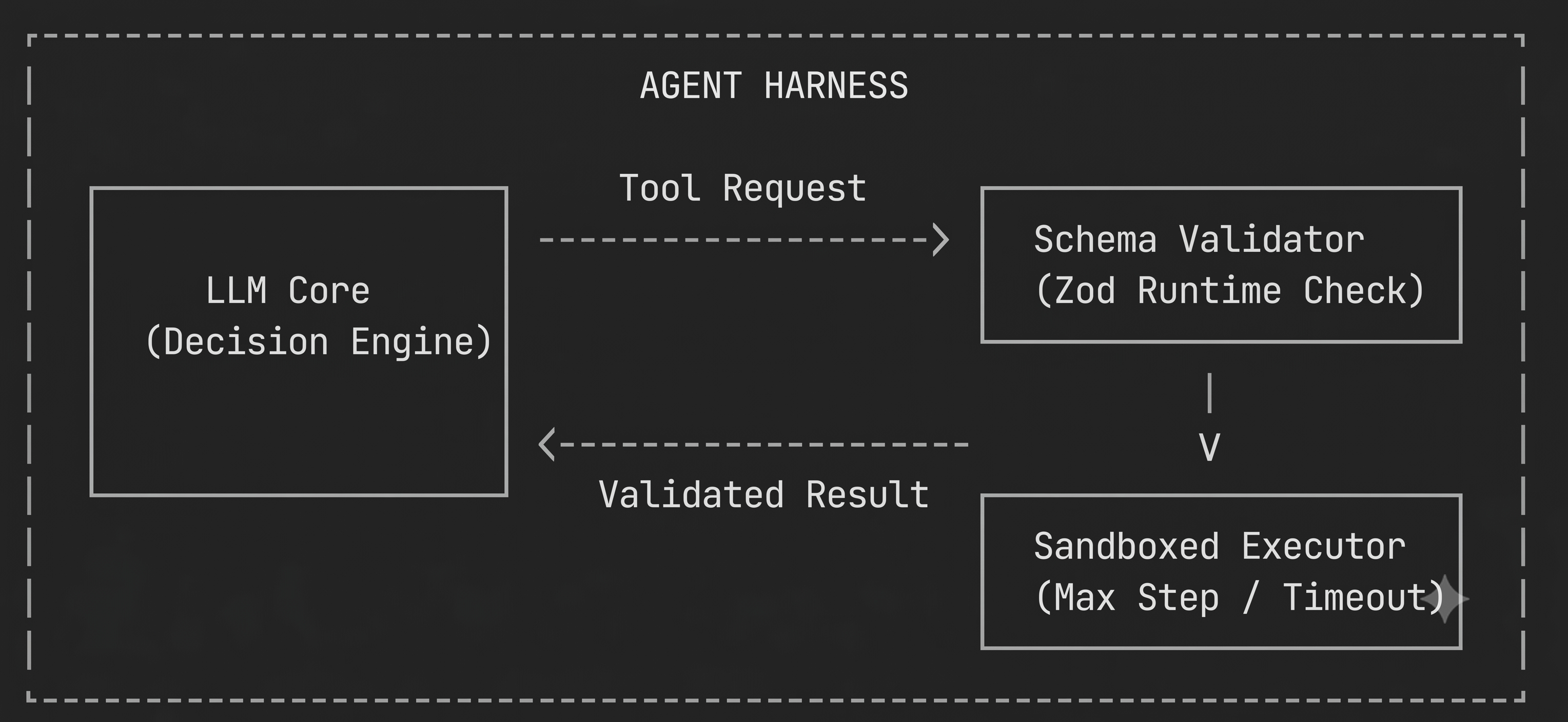
An Agent Harness decouples decision-making from execution safety. The LLM decides what action it wants to take, but the harness decides whether that action is permissible, safe, and syntactically correct.
Core Pillars of a Production Agent Harness
To make an autonomous agent reliable enough for enterprise deployment, your harness must enforce four foundational guardrails:
- Step and Budget Constraints: Every agent execution run must have a strict upper limit on step iterations, token usage, and execution time. If an agent loops five times without making progress, the harness terminates the execution gracefully.
- Strict Tool Input Validation: You should never pass raw LLM tool call arguments directly to an API. The harness validates all parameters against a runtime schema library like Zod before invoking any function.
- Context Memory Pruning: Long-running agents suffer from prompt window bloat. The harness manages the conversation context, trimming stale tool outputs while preserving core instructions and system state.
- Deterministic Fallbacks: When a tool call returns an error or a 500 status code, the harness intercepts the exception and provides formatted context to the model, guiding it toward a recovery strategy instead of crashing the process.
Technical Implementation: A Production-Ready TypeScript Agent Harness
Below is a complete, lightweight implementation of a production-grade Agent Harness written in TypeScript. It demonstrates step-limiting, runtime schema checking via Zod, tool sandboxing, and execution logging.
import { z } from 'zod';

// 1. Define strict type interfaces for tools and harness state
export interface ToolDefinition<TParams extends z.ZodType = z.ZodType> {
  name: string;
  description: string;
  schema: TParams;
  execute: (args: z.infer<TParams>) => Promise<unknown>;
}

export interface HarnessConfig {
  maxSteps: number;
  timeoutMs: number;
}

export interface AgentStepResult {
  stepNumber: number;
  toolName: string;
  args: unknown;
  result: unknown;
  success: boolean;
  error?: string;
}

export interface ExecutionSummary {
  status: 'COMPLETED' | 'MAX_STEPS_EXCEEDED' | 'TIMEOUT' | 'FAILED';
  history: AgentStepResult[];
  finalOutput?: string;
}

// 2. The core Agent Harness implementation
export class AgentHarness {
  private tools: Map<string, ToolDefinition> = new Map();
  private config: HarnessConfig;

  constructor(config: HarnessConfig) {
    this.config = config;
  }

  // Register tools with strict schema validation
  public registerTool<T extends z.ZodType>(tool: ToolDefinition<T>): void {
    this.tools.set(tool.name, tool as ToolDefinition);
  }

  // Execute a single tool safely within the harness boundary
  public async executeToolCall(toolName: string, rawArgs: unknown): Promise<{ success: boolean; data?: unknown; error?: string }> {
    const tool = this.tools.get(toolName);

    if (!tool) {
      return { success: false, error: `Tool "${toolName}" is not registered in this harness.` };
    }

    // Validate parameters at runtime before execution
    const parseResult = tool.schema.safeParse(rawArgs);
    if (!parseResult.success) {
      return {
        success: false,
        error: `Invalid tool parameters: ${parseResult.error.issues.map(i => i.message).join(', ')}`
      };
    }

    try {
      // Run execution with sandbox error handling
      const output = await tool.execute(parseResult.data);
      return { success: true, data: output };
    } catch (err) {
      const errorMessage = err instanceof Error ? err.message : 'Unknown execution failure';
      return { success: false, error: `Tool execution failed: ${errorMessage}` };
    }
  }

  // Run the agent loop under harness constraints
  public async runLoop(
    stepGenerator: (history: AgentStepResult[]) => Promise<{ action: 'CALL_TOOL' | 'FINISH'; toolName?: string; args?: unknown; text?: string }>
  ): Promise<ExecutionSummary> {
    const history: AgentStepResult[] = [];
    const startTime = Date.now();

    for (let step = 1; step <= this.config.maxSteps; step++) {
      // Check execution timeout
      if (Date.now() - startTime > this.config.timeoutMs) {
        return { status: 'TIMEOUT', history };
      }

      // Query the LLM decision engine
      const decision = await stepGenerator(history);

      if (decision.action === 'FINISH') {
        return {
          status: 'COMPLETED',
          history,
          finalOutput: decision.text || 'Task completed successfully.'
        };
      }

      if (decision.action === 'CALL_TOOL' && decision.toolName) {
        const execution = await this.executeToolCall(decision.toolName, decision.args);

        const stepLog: AgentStepResult = {
          stepNumber: step,
          toolName: decision.toolName,
          args: decision.args,
          result: execution.data || null,
          success: execution.success,
          error: execution.error
        };

        history.push(stepLog);
      }
    }

    return { status: 'MAX_STEPS_EXCEEDED', history };
  }
}
Example Usage: Registering a Secure Tool
Here is how a developer registers a database lookup tool within the harness. Notice how the Zod schema prevents invalid database queries from ever reaching your backend:
// Define a schema for user queries
const FetchUserSchema = z.object({
  userId: z.string().uuid({ message: "userId must be a valid UUID" }),
  includeOrders: z.boolean().default(false)
});

const harness = new AgentHarness({ maxSteps: 5, timeoutMs: 15000 });

harness.registerTool({
  name: 'fetchUserProfile',
  description: 'Retrieves user profile data from the database.',
  schema: FetchUserSchema,
  execute: async (args) => {
    // This code only runs if args pass UUID validation
    return { id: args.userId, name: 'Alex Developer', orders: args.includeOrders ? [] : undefined };
  }
});
Strategic CTO Perspective: Why Investment in Harnesses Matters
From a business and architecture perspective, an un-harnessed AI agent is a financial and security risk.
Implementing a robust harness infrastructure delivers immediate operational advantages:
- Predictable API Costs: By capping max steps and token budgets, you eliminate surprise bills caused by infinite recursion loops.
- System Stability: Malformed LLM outputs are caught and handled in memory rather than causing unhandled promise rejections in serverless functions.
- Security & Compliance: Every tool execution passes through a central point, making it simple to inject authorization checks, rate limits, and audit logs.
As autonomous agents become central to enterprise applications, the competitive advantage shifts from who has the best prompt to who has the best harness engineering.
Building autonomous AI agents or complex tool integrations for your business? Groooh specializes in enterprise AI architecture, agent harness engineering, and secure API integration pipelines. Contact our engineering team to review your technical roadmap.
A seasoned systems architect with over a decade of experience guiding venture-backed startups and growth teams from 0-to-1 MVP delivery to scale. Specializes in cross-platform mobile architectures, resilient cloud infrastructure, and applied agentic AI integrations that drive measurable commercial impact.
Add Groooh to Preferred Sources
Top Stories & AI Overviews
Prioritize our engineering & AI guides in your Google Top Stories & AI Overviews.
Ready to build your next breakthrough product?
Let’s collaborate on your architecture roadmap, MVP sprint, or full product build with our senior team.