

AI Meal Planner
Personalized Meal Planning Powered by Artificial Intelligence

What is it?
It started with a question almost everyone asks at some point: what should I eat this week? The AI Meal Planner is a mobile app that actually answers that question, intelligently and personally. You tell it your preferences, your dietary goals, any restrictions you have, and it generates a meal plan built around you. Not a generic list pulled from a database. A real, thoughtful suggestion based on what you actually told it. From there, you can accept meals, swap ones you do not like, build out your weekly plan, and then let the app tell you exactly what ingredients you need to make it all happen. We handled the full build on this one, from design to development to AI integration.
The Problem
Meal planning sounds simple but it is genuinely hard to do consistently. Most people either skip it entirely and end up making poor food choices, or they start a plan on Sunday and abandon it by Wednesday because something did not work out. The tools that existed were either too rigid or too manual. Generic recipe apps give you thousands of options with no guidance. Rigid diet plans tell you exactly what to eat with no flexibility. Neither of those feels like it was made for a real person living a real life. The client wanted something that sat in the middle: smart enough to do the thinking for you, but flexible enough that you actually stick with it.
What We Built
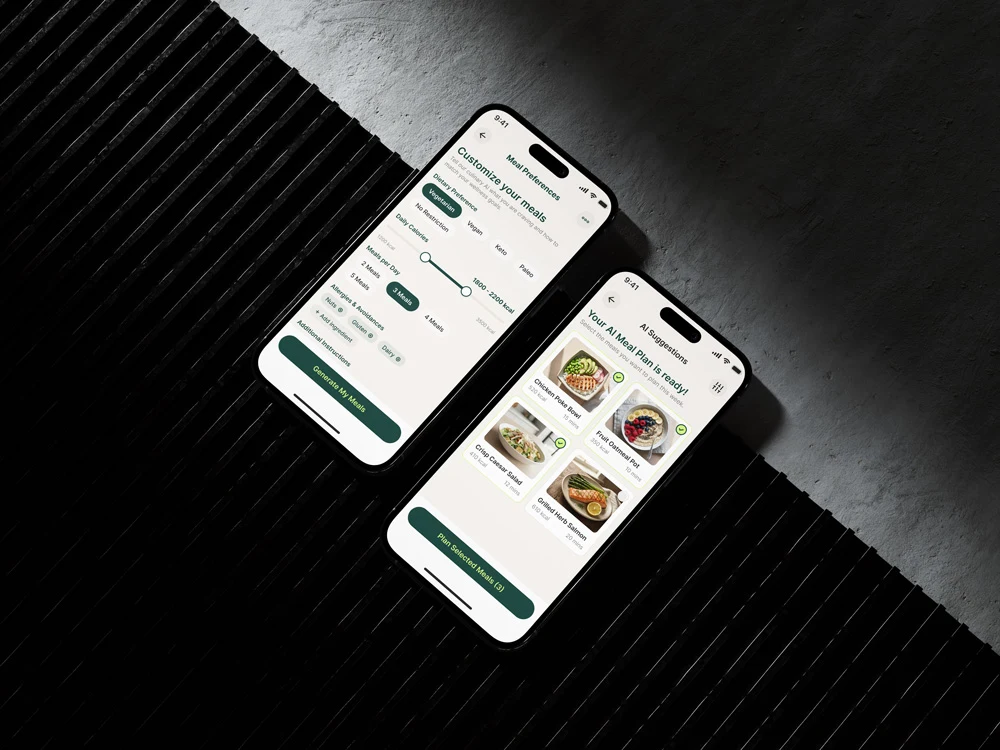
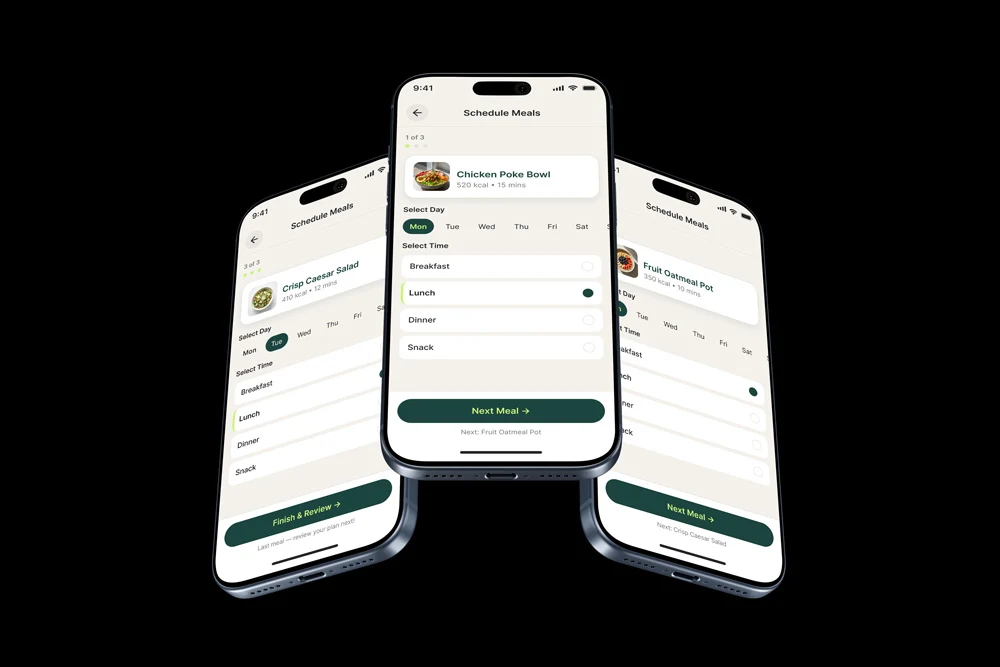
The app opens with a short onboarding flow where the user sets their profile. Dietary preferences, allergies, fitness goals, how many people they are cooking for, and how much time they typically have. That information feeds directly into the AI layer. Once set up, the user can request a meal plan for the week or for specific days. The AI generates suggestions that match their profile, with a name, a brief description, nutritional info, and a preparation time for each meal. The user can accept a meal, swap it for something else, or ask for a completely different suggestion. Once the plan is set, the app compiles a full ingredient list automatically. It groups ingredients by category, marks quantities, and can be used as a shopping list directly in-store. No more writing things down, forgetting one item, and ending up back at the supermarket the next day.
The Design Approach
The design needed to feel approachable and a little warm, not clinical or diet-app-ish. Meal planning already carries a bit of psychological weight for a lot of people. The last thing the app needed to feel like was a food tracking app judging your choices. We went with a clean, food-forward visual style. Warm neutrals, generous use of food photography, and a card-based layout for meals that felt more like browsing a menu than managing a schedule. The meal cards were designed to make food look appealing, because if the app makes you excited about what you are going to eat, you are much more likely to actually cook it. The ingredient list screen was designed to be genuinely useful in a kitchen or a supermarket aisle. Large text, clear groupings, and a simple checkoff system for items already picked up.
The AI Layer
This was the most technically interesting part of the project. The AI integration needed to be conversational enough to feel personal but structured enough to produce reliable, usable output. We built the instruction interface to be natural. Instead of making users fill out a complex form every time, they can type or speak what they want in plain language: "I want something quick for dinner tonight, nothing with dairy." The AI picks that up, matches it against the user's saved profile, and returns suggestions that actually make sense. The meal generation was built to get smarter over time. When a user consistently swaps certain meals or marks others as favorites, that behavior feeds back into future suggestions.
What Made This One Different
A lot of apps bolt AI onto something that did not need it. This one genuinely needed it. The whole premise falls apart without an AI layer that actually understands context and produces varied, useful suggestions. Getting that right, making it feel natural rather than robotic, was the core challenge of the project. We spent a lot of time on the prompt architecture and the output formatting to make sure what came back from the AI was always usable, never random.
What We Delivered
| Deliverable | Detail |
|---|---|
UI/UX Design | Full Figma design system, onboarding, planner, meal cards, ingredient list |
Development | React Native, iOS and Android |
AI Integration | Natural language meal generation, preference learning |
Meal Planning Engine | Weekly and daily plan builder with swap functionality |
Ingredient Aggregator | Auto-compiled shopping list with categories and quantities |
User Profiles | Dietary preferences, allergies, goals, household size |
Want Us to Work on Your AI Integrated App?
Let's Do it
Let's Do it

